What was signed, not what was typed.
We read the agreement itself, including the amendments, emails and side notes around it.
One screen per process. Every record that arrived since yesterday, checked against every agreement in force, with the clause next to it and a decision for your team to make.
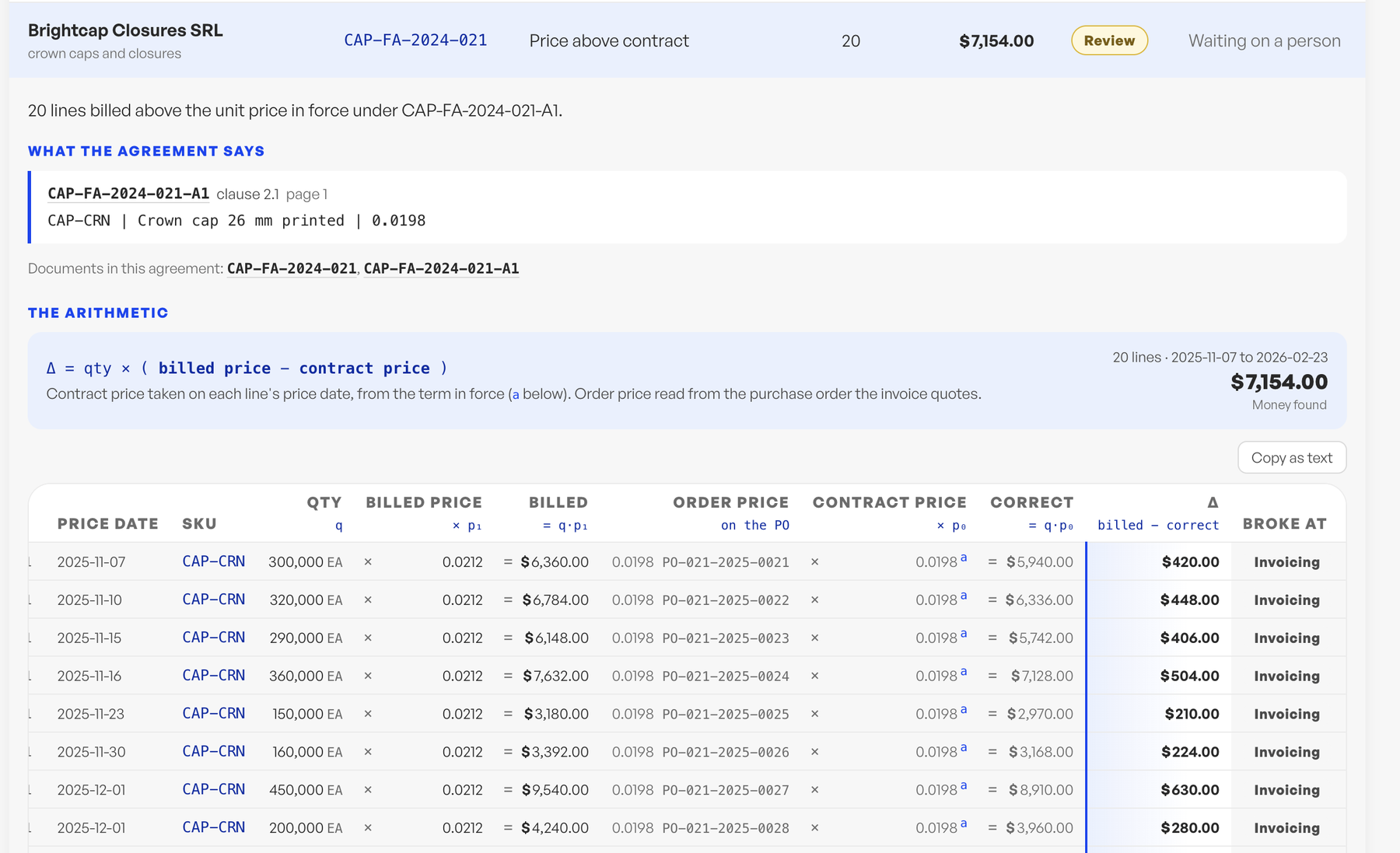
Evenrow reads the agreement itself: the signed document, its amendments, and the emails and side notes that changed it. Each obligation is written down with the clause it comes from, in the agreement's own words, so a person can check the reading.
Each obligation is connected to the records it governs: invoices, orders, deliveries, certificates, lab results, carrier bills. To begin, these come as exports from your systems. Nothing is installed, and nothing is changed.
Every new record is checked against every agreement in force, every morning. A price against the clause that sets it. A rebate against the volume that earns it. A surcharge against the tariff that allows it, or does not.
Your team sees the clause next to the record and confirms or rejects. What they confirm becomes the record. What they reject is kept too, with the reason, so the same question is not asked twice.
An obligation with no record is shown as unchecked, with the record it needs. You always know what has been checked, what has not, and what is missing to close the gap.
Checked obligations show the clause and the records they were checked against.
Unchecked obligations name the export that would close them.
Nothing is reported as clean unless it was actually checked.
Each rule is dated, carries its clause, and is never decided again. When an amendment changes the price basis, your team confirms the new reading once. Every invoice after that follows it, and the answer is the same every morning. Year two is better than year one, because the decisions your team already made are part of the product.
The unit price is the price list in force on the order date.
Applies to every invoice line under this agreement from 14 June. Checked 1,204 lines since. Two exceptions found, both confirmed.
Illustration. Fictional company and figures.
The Analyst answers questions on the record. It never invents: it returns what was agreed and what happened, with the clause or the line, or it says what it would need to answer.
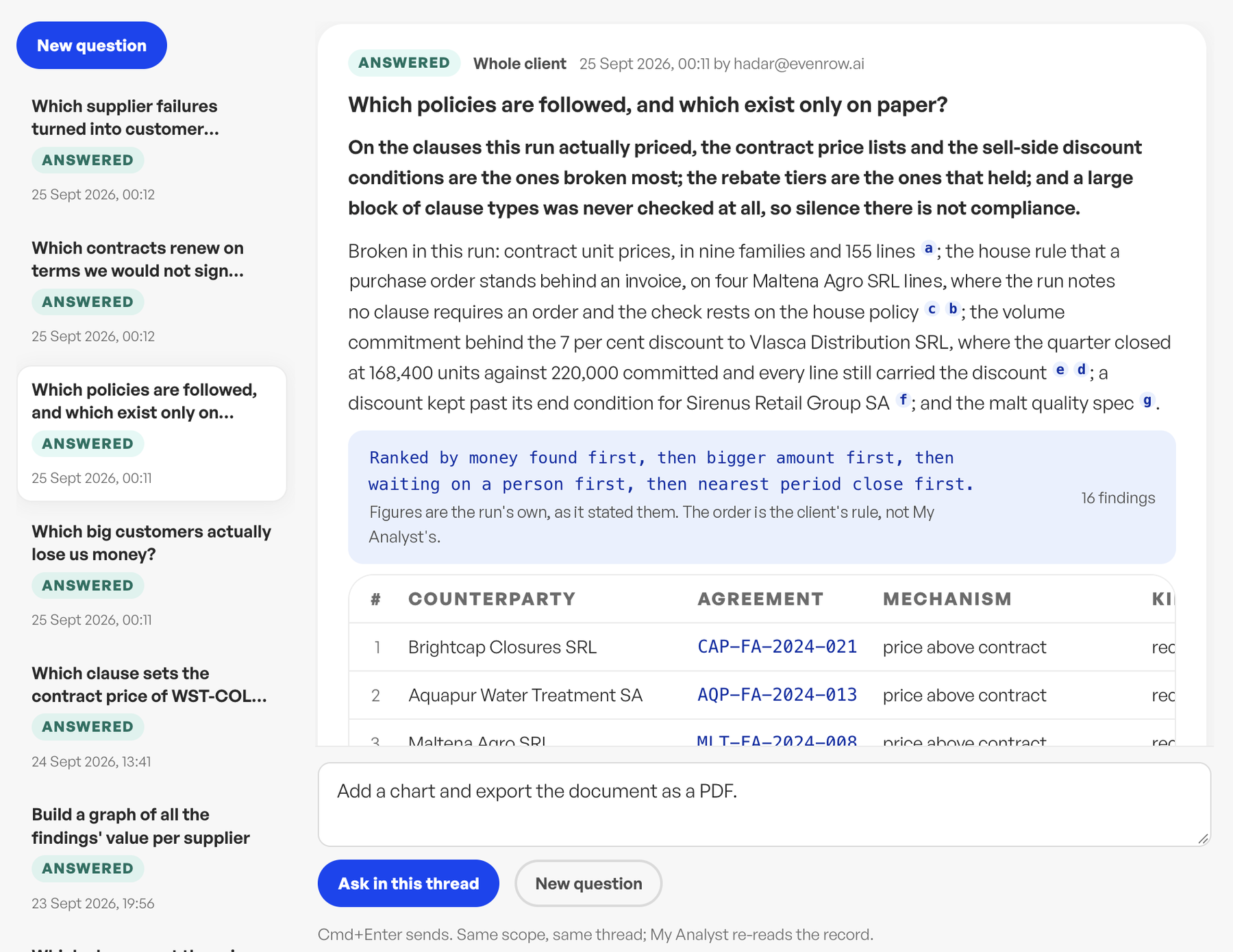
We read the agreement itself, including the amendments, emails and side notes around it.
Not once a year, and not a sample.
The clause sits next to the record it governs, and nothing counts until your experts confirm it. Each rule is set once and kept, so the answer is the same every morning.
Six examples. Most customers start where the money leaves: supplier agreements against invoices. Any other process that runs on agreements you negotiated is the same product, on another set of records.
Prices, discounts, rebates and payment terms agreed with each supplier, checked on every invoice.
See the flowSellDiscounts and promotion funding given to customers, checked against the volume they committed to.
See the flowSellWhat each customer agreed to pay, checked against what you billed.
See the flowMakeThe specification each supplier agreed to, checked against the certificate and your own lab.
See the flowMakeEach batch, checked against its specification, its supplier lots and the complaints that came back.
See the flowMoveFreight and logistics prices agreed with each carrier, checked on every delivery invoice.
See the flowSend us the exports for one process. A month later your team sees every record of that process against the agreements that govern it, with the clause next to each one.
contact@evenrow.ai