What was signed, not what was typed.
We read the agreement itself, including the amendments, emails and side notes around it.
The commitment. Discounts and promotion funding given to customers against the volume they committed to.
We read the agreement itself, including the amendments, emails and side notes around it.
Not once a year, and not a sample.
The clause sits next to the record it governs, and nothing counts until your experts confirm it. Each rule is set once and kept, so the answer is the same every morning.
The discount is priced into every invoice from day one. If the customer buys behind pace, nothing alerts until year-end. By then the discount has been given on twelve months of invoices, against a volume that never arrived.
Illustration. Fictional company and figures.
A retail chain receives 6% off every invoice, against a commitment of 240,000 cases in the year.
The discount is applied from January. Nobody looks at the pace again.
Seven months in, the chain has taken 98,000 cases. The pace the discount assumes is 140,000.
Evenrow shows the volume clause next to the running total, and what the discount is worth at the current pace against the pace agreed.
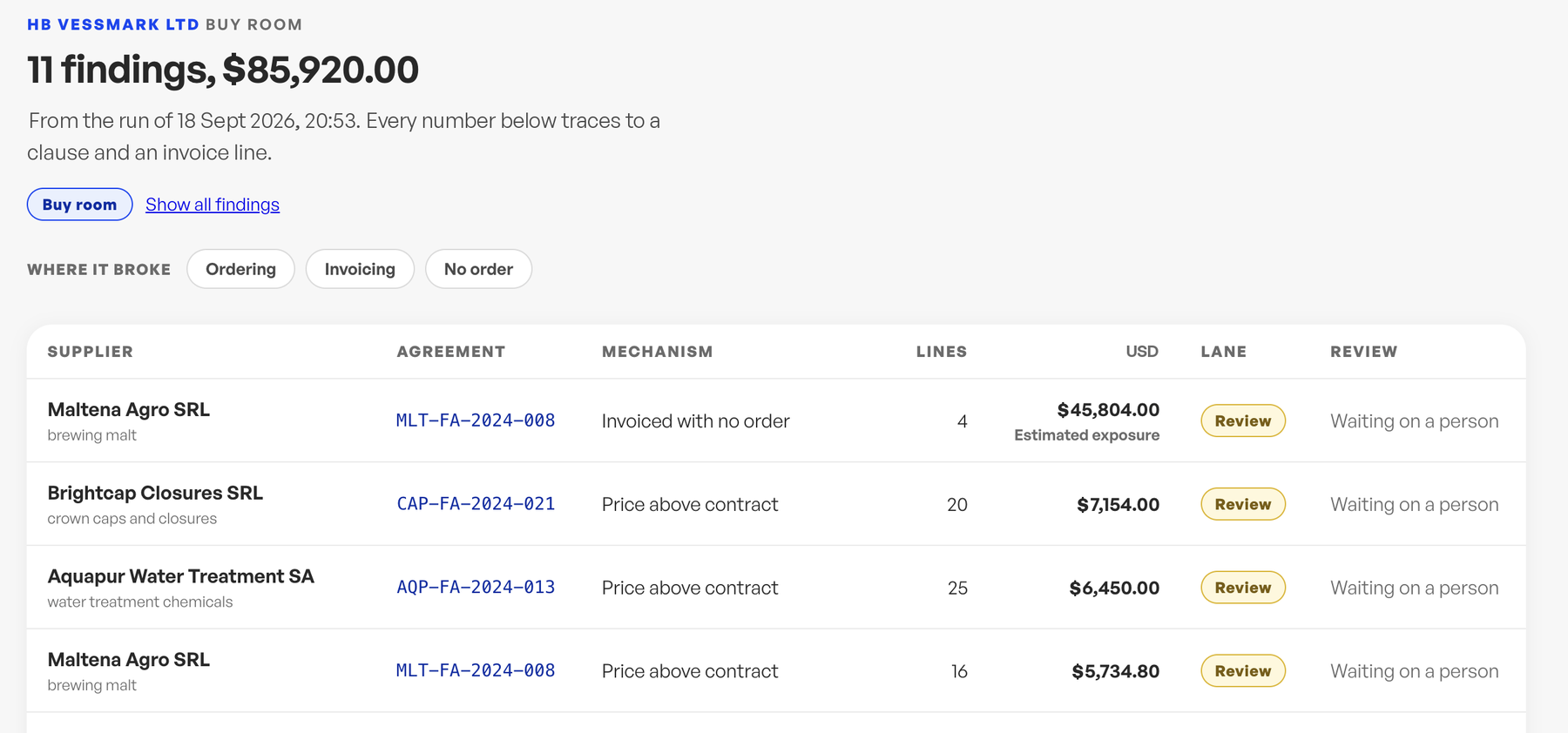
Every customer agreement with a volume condition, with the volume so far against the pace agreed. Every invoice that carried the discount, next to the clause that earns it. A customer behind pace is visible in month two, not at year-end.
One process, one month, on data exports, no integration. You choose the process. We read the agreements and the exports, and a month later your team opens this page on your own records.
Send us the exports for one process. A month later your team sees every record of that process against the agreements that govern it, with the clause next to each one.
contact@evenrow.ai